
When the nodes want to talk: an introduction to BIP-110
Let’s imagine the Bitcoin network as a shared highway. Everyone can move through it, but not everyone agrees on what uses are desirable. For some, the intensive use of arbitrary data (inscriptions, blobs, etc.) is a legitimate evolution of the system.
For others, the same use conmanages the network and raises the commissions, affecting those who only want to make simple monetary transactions.
This disagreement is not new in Bitcoin. The relevant thing is how it is managed. Bitcoin has no leaders or formal votes: decisions are not proclaimed, they are implemented. However, distinguishing between debate, intention and real action is not always simple.
In this context, the BIP-110a proposal that seeks to provide node operators with a clearer way of expressing technical preferences, without imposing permanent changes or forcing the entire network to follow them.
What is BIP-110?
The BIP-110 (Reduced-Data Temporary Soft-Fork) is a temporary and voluntary soft fork which proposes to reduce, for a limited period (approximately one year), certain uses of arbitrary data in Bitcoin.
Relevant aspects of the proposal:
- Who proposes: a developer under the pseudonym Dathon Ohm.
- When it was proposed: Public discussion on BIP-110 began in October 2025 within the distribution list of Bitcoin developers, as documented here. In parallel, the formal draft of the proposal was presented BIP-110. It is important to note that, as of the date of this article, the proposal has not yet been accepted in the official repository, remaining as a pending request for approval.
- What are you proposing: a soft fork the size of non-financial data in transactions (outputs ≤ 34 bytes, OP _ RETURN ≤ 83 bytes, puzzles ≤ 256 bytes, among other restrictions).
- For what purpose: provide node operators with a practical form of to actively identify its disagreement with the massive use of arbitrary data, without imposing permanent changes to the consensus.
In summary, specific technical restrictions such as:
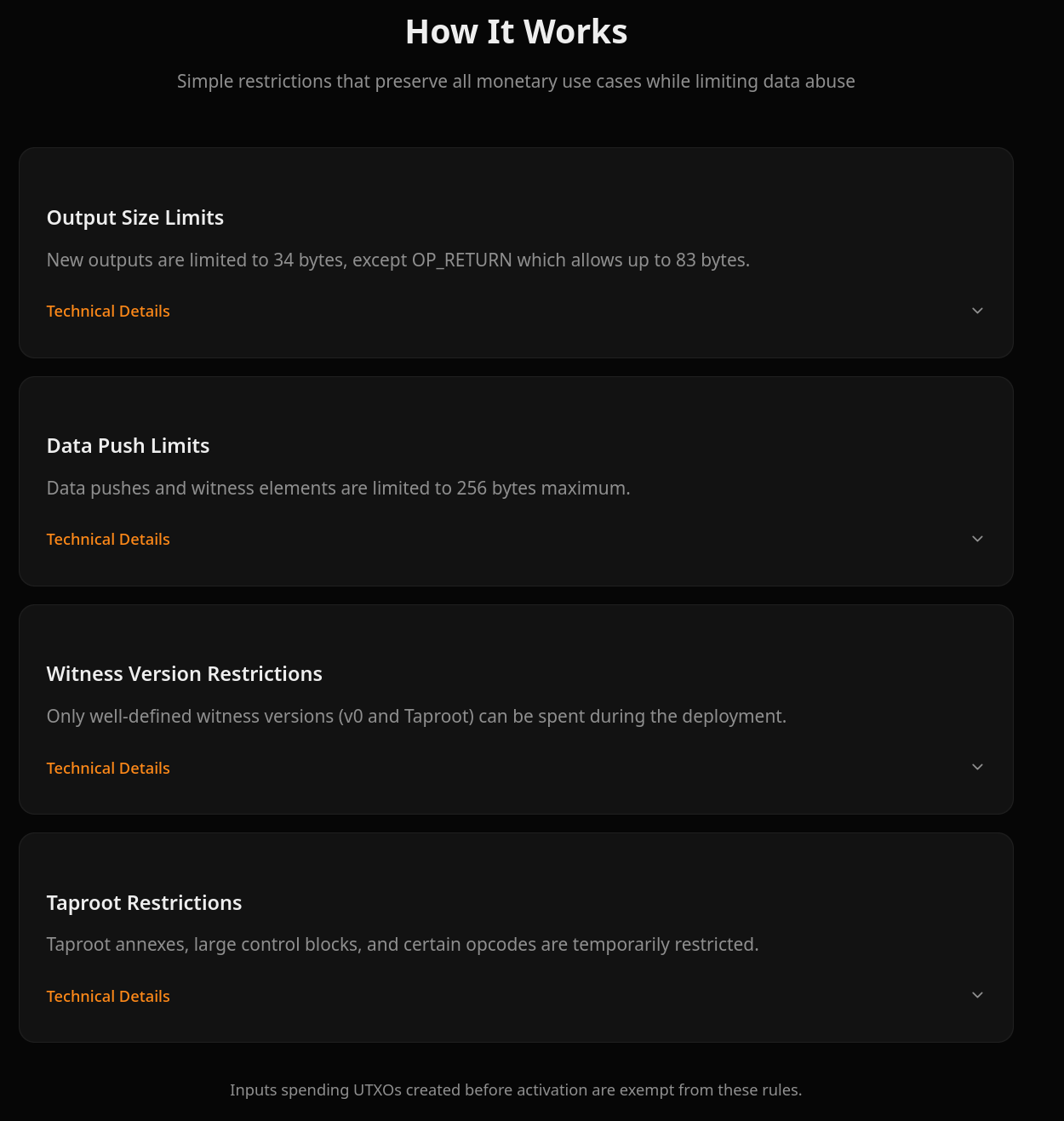
- New outputs limited to 34 bytes (except OP _ RETURN, up to 83 bytes).
- Witness and data puthes limited to 256 bytes.
- The UTXOs created before activation are exempted, avoiding breaking the existing history.
- Additional restrictions specific to Taproot (e.g., annexes and large block control).
It is important to highlight two key points:
- Not permanent.: the rules expire automatically.
- Not global.: only apply to nodes that decide to activate it.
Nodes that do not activate it continue to operate under Bitcoin’s usual rules without being affected.
What's the BIP-110 target?
Defenders BIP-110:
- they present it as a tool of practical signallingNot discursive.
- Instead of expressing preferences through debates, statements or social networks, the operator of a node can do so by running specific rules in its own node.
- The character temporary is central to this proposal: it does not seek to «win forever,» but to create a transition window so that those who depend on large volumes of arbitrary data can adapt, optimize their designs or explore alternatives.
Critics of this proposal argue that:
- It compromises the insensiability of Bitcoin.
- Add a layer of complexity the validation of the network.
- It could generate fragmentation. between the nodes operators.
- Introduce conflict of an economic and social nature in the technical field.
- Set a precedent implementation of «exceptional modes» that could be invoked again.
The BIP-110 does not resolve this disagreement: makes it visible.
What is needed to participate?
Participate in BIP-110 it’s not automaticBut it’s not too complex either.
It is necessary:
- Run a complete node of Bitcoin.
- Use a software that implements BIP-110. This functionality is currently explicitly available in specific versions derived from Bitcoin Knots, maintained by the author of the BIP.
Participation takes place when running the compatible softwarewhich directly incorporates the rules and the activation schedule defined by the BIP.
It is not enough to modify the user agent or simply «declare» support for the BIP. Without the necessary software, the node will work like any other.
How do you "vote"?
In Bitcoin, symbolic voting does not exist. The signage is manifested when your node carries out the following actions:
- Valid blocks applying stricter rules.
- Rejection blocks that do not comply with those rules.
- Face the consequences if most of the network does not take the same position.
This rejection is observable and has real effects.
For BIP-110 advocates, this mechanism represents a genuine form of show that there are real interests at stake.
For its critics it is an additional burden for individual operators, especially in the face of the possibility of being temporarily out of consensus.
So, more than a plebiscite, it is a technical decision involving specific costs.
Activation period and process
BIP-110 defines two activation pathwaysboth explicit in their design.
Early signalling activation
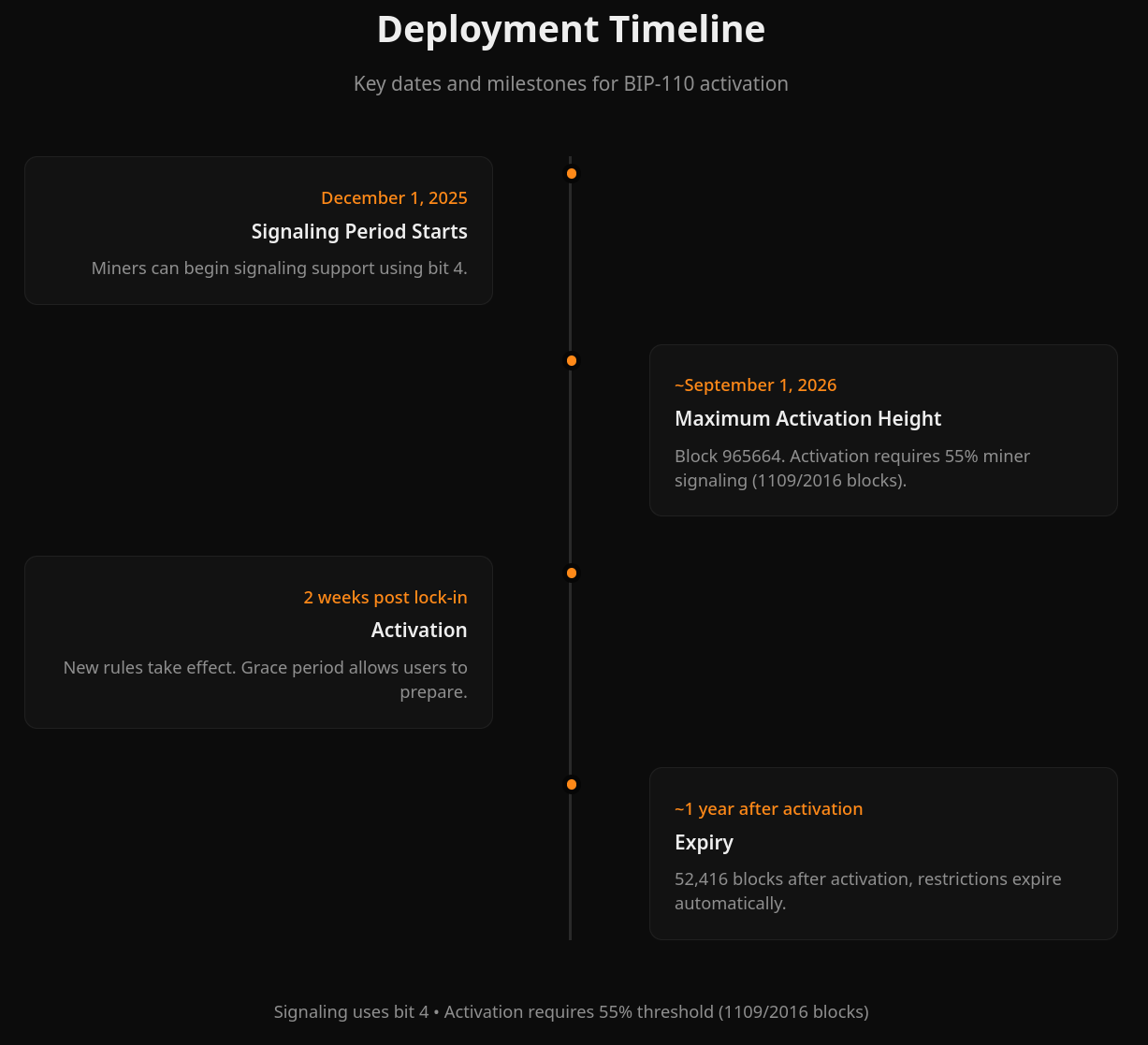
- Signage: The 1 December 2025. Miners signal support by setting bit 4 in the block version (put a «1» in that position) to read: «I support the BIP-110».
- Early activation threshold: Up to about September 2026 (around block 965,664), the network measures the support of miners in «windows» fixed of 2,016 consecutive blocks (as voting rounds of about 2 weeks each). If in any of those rounds at least 55% of blocks (1,109 or more than 2,016) bear the support mark (bit 4 in «1»), the «lock-in» (lock or «lock»). It’s like most people say, «We shall proceed.».
- Activation: If there is lock-in, the new rules come into force about 2 weeks later (to give time for everyone to update without chaos). It could happen between February and September 2026, depending on how much support there is.
Block height activation («flag day»)
- Unconditional Fallback: If 55% is not reached before, BIP-110 is activated anyway in block 965,664 (around September 2026). It’s a «deadline» so it won’t be in limbo.
- Duration: Once activated, the rules last ~1 year (52,416 blocks)
Once activated (by either path), the restrictions remain in effect for about 52,416 blocks (≈ one year). After approximately one year, the rules expire automatically and the node returns to normal Bitcoin rules.
Expiration: At the end of the year, restrictions are automatically deactivated. There is no need to do anything; the compatible software (like Knots) automatically returns to the normal Bitcoin rules.
Now, let’s see how all this works in practice, step by step, as if we were following a road:
Imagine that from the 1 December 2025 a period of «consultation» on the net. The miners who want to support the BIP-110 start to put a special mark (the bit 4 in «1») in the lying blocks. It’s his way of saying: «I agree with temporarily limiting certain intensive data uses (what their defenders call «spam,» although their critics see as legitimate innovation). «
Meanwhile, anyone like you or me can install the version of the software that supports the BIP (fork of Bitcoin Knots). With this, our node is ready to apply the strictest rules when the time of activation comes (refuse only after activation, not during signalling).
For months (up ~September 2026), the network tells how many blocks that support mark carry. If in any section of 2,016 consecutive blocks more than 55% have the bit 4 in «1»Ready! Change is activated in about two weeks.
The miners, who live from their blocks being accepted by the economic majority (exchanges, wallets, real users), have a strong incentive to follow the rule, because if not, their blocks could be rejected and they would lose money.
But if the miners do not agree and do not reach 55%, nothing is wrong: the BIP-110 has a «deadline». When you get to the block ~965,664 (around September 2026), the rules are activated anyway. From there, any node that runs the compatible software (like Knots with the enabled option) will start to reject blocks that include excessive data (the «spam» which conmanages).
During the following year (52,416 blocks), the network tests this «temporary anti-spam mode». Those who use Bitcoin only for normal payments hardly notice anything; those who depend on large files or mass inscriptions have time to adapt, migrate to other solutions or prepare new proposals.
After the year, everything automatically expires. The temporary restrictions automatically drop, and Bitcoin returns exactly as he was before. No one gets caught forever.
What if the support is low or divided?
Although the BIP-110 is activated in all ways in block 965.664 (or before if there are 55% signaling), their real effectiveness depends on economic consensus: if sufficient important nodes (exchanges, wallets, users with real BTC) run Knots with the option activated, miners are forced to comply with the rules (so that their blocks are accepted and can sell their rewards).
The activation is defined at the software level, but its practical impact depends on how many relevant actors actually decide to apply those rules.
If the support is minority (as now, only ~2.4% of nodes), a node running the BIP-110 software is temporarily frozen, i.e. you will not see new blocks, nor will you be able to confirm new transactions, nor will you be able to send or receive new payments through that node for the time the BIP lasts. Similarly a bitcoin owner does not lose them (his keys continue to control the UTXOs), but the node will stop following the majority chain until the expiry of the temporary rules (~1 year later), when everything returns to normal and synchronizes the main chain. It is uncomfortable, but reversible and without existential risk. You can disable the option or change software whenever you want.
This is what the advocates of this BIP claim in favour: allows to test a limit without imposing it eternally. If it works well, the community can propose something permanent later; if not, it simply ends and learns.
The critics of BIP-110 They consider it risky and useless, arguing that it adds unnecessary complexity, sets a dangerous precedent by forcing the activation without consensus and fear fragmentation. They think the spam already reasonably managed with dynamic commissions and see ‘temporary mode’ as a diversion of resources from structural improvements (such as Lightning), without guarantee of success.
In summary: some see a controlled and sovereign experiment; others, a complication that could open the door to more controversial future interventions.
The good thing about Bitcoin is that no one forces you to choose a side: you decide whether to run Knots with the option activated or not.
At the time of publication (February 2026), the support remains very limited: only about 2.4% of the nodes run it, and the marking of miners is almost zero.
You can check up on independent trackers such as The Bitcoin Portal.
What if it is activated with strong support?
If the activation of BIP-110 gets strong financial support (nodes, exchanges, wallets), miners are expected to adapt to maintain commissions.
That is, once activated:
- Transaction restriction: Transactions that exceed the limits of BIP-110 are considered invalid and are excluded from new blocks.
- Historical integrity: The history of Bitcoin prior to activation is not altered.
- Temporary application: Special rules only apply during the prescribed period.
The BIP-110 design stipulates that, at the end of the established period, the rules expire automatically. With this, the network reacts the validation of blocks under the usual rules, without requiring further updates or additional decisions.
Outlook and Dispute:
Despite this reversibility, there is no certainty that the process will be fully orderly and that the expected economic effects will be achieved.
As I have already mentioned, therefore, while its defenders present it as a and reversible experiment, its detractors call it a unnecessary risk or an inappropriate means of bringing the use disagreements to the level of consensus.
What happens when the period ends?
As we have already said. After the time limit defined, the BIP-110 design itself states that time rules are not automatically applied. No additional action or updating of the software is necessary for this to happen.
From that moment on, the nodes revalidate blocks according to the usual Bitcoin rules. There are no permanent changes in the consensus and no changes in the history of transactions.
If, after that period, it was considered necessary to move in another direction, either to maintain similar restrictions, to modify them or to discard them, it would be essential to present a new proposal and to rebuild consensus on the network.
In this sense, the BIP-110 is not intended to be a definitive solution, but a time-limited mechanism to express technical preferences and facilitate an orderly transition without irreversibly compromising the rules of the system.
Beyond BIP-110: why run a node matters
The debate on proposals such as the BIP-110 highlights an essential truth in Bitcoin:
Operating a node goes far beyond checking transactions. It’s a active decision: what rules you accept, what changes you consider legitimate and how far you are willing to put resources and responsibility to defend your position.
These cases expose the central tension in Bitcoin: how to ensure that node operators have an effective voice without their decisions being imposed on the rest of the network.
The key is not to support or reject a specific BIP, but to safeguard a system where nodes are not mere observers, but participants with genuine influence.
That delicate balance between individual sovereignty and collective consensus is precisely what makes Bitcoin unique.
Remember, you have the power to participate. Run your own node, define your rules. It’s, as I like to say, have. «skin in the game”.
And in a world that tends to centralize control, that’s no small thing: it’s freedom in action.
References and notes
References:
- Official BIP-110 text and documentation: https: / / bip110.org
- Press official request in the Bitcoin proposal repository: https: / / github.com / bitcoin / bikes / pull / 2017
- The BIP was proposed by Dathon Ohm, with roots in previous discussions led by operators and critical developers of certain consensus changes: https: / / studyknots.com / guides / bip-110
- BIPs cloned repository maintained by the author of the BIP-110 (not the official BIPs repository, but contains the active draft of the BIP-110): https: / / github.com / dathonohm / bips / blob / reduced-data / bip-0110.mediawiki
- Monitoring of nodes running compatible software: https: / / thebitcoinportal.com / nodes / bip110
Notes:
- While Bitcoin Knots is the client on whom the most visible integrations related to BIP-110 have been performed, the releases specifically prepared for activation not distributed from the main repository of Bitcoin Knots, but from the repository maintained by the author of BIP-110, Dathon Ohm, who has made available versions compiled in: https: / / github.com / dathonohm / bitcoin / releases
It’s very recommended to check carefully downloads before running this type of software, validating GPG signatures and SHA256 hashes always, to minimize the risk of running malicious or compromised software. Trust is built by checking, not assuming.
- In addition, some Nodes solutions «all in one» how Start9, Ummel, MyNode and Parmanode, are facilitating the installation of Knots versions compatible with the BIP-110, allowing a simple implementation on their respective Nodes. (The availability and level of support may vary depending on the platform and version used.) For more details, visit: https: / / bip110.org / howto /.

Puedes dejar una propina con el botón «Invítame un café».
O mediante Lightning network:
También puedes hacerlo onchain, vía Paynyms de Samourai Wallet:
PayNym: +decentralized